One of the most common things I hear from clients is some version of:
“My locs are already frizzy.”
Sometimes this is a week after a retwist. Sometimes it is three days later. Sometimes we have barely finished the service and somebody has already located one fuzzy little hair that decided it did not sign the agreement. 😂
Here is the thing: frizz is normal.
Especially with locs.
Your hair does not stop behaving like hair simply because you decided to loc it. It still grows, sheds, expands with moisture, reacts to humidity, moves around while you sleep, and does all of the other things hair naturally does.
A little frizz does not mean something has gone wrong.
Why Locs Get Frizzy
Locs form because strands of hair begin tangling, matting, and intertwining with one another.
That process is not perfectly smooth.
Loose strands are constantly finding their way into the loc. New growth is coming in at the scalp. Shorter hairs may stick out along the length. Shed hairs can become incorporated into the loc over time.
All of that can create frizz.
And if your locs are still young, you may see even more of it while they are developing.
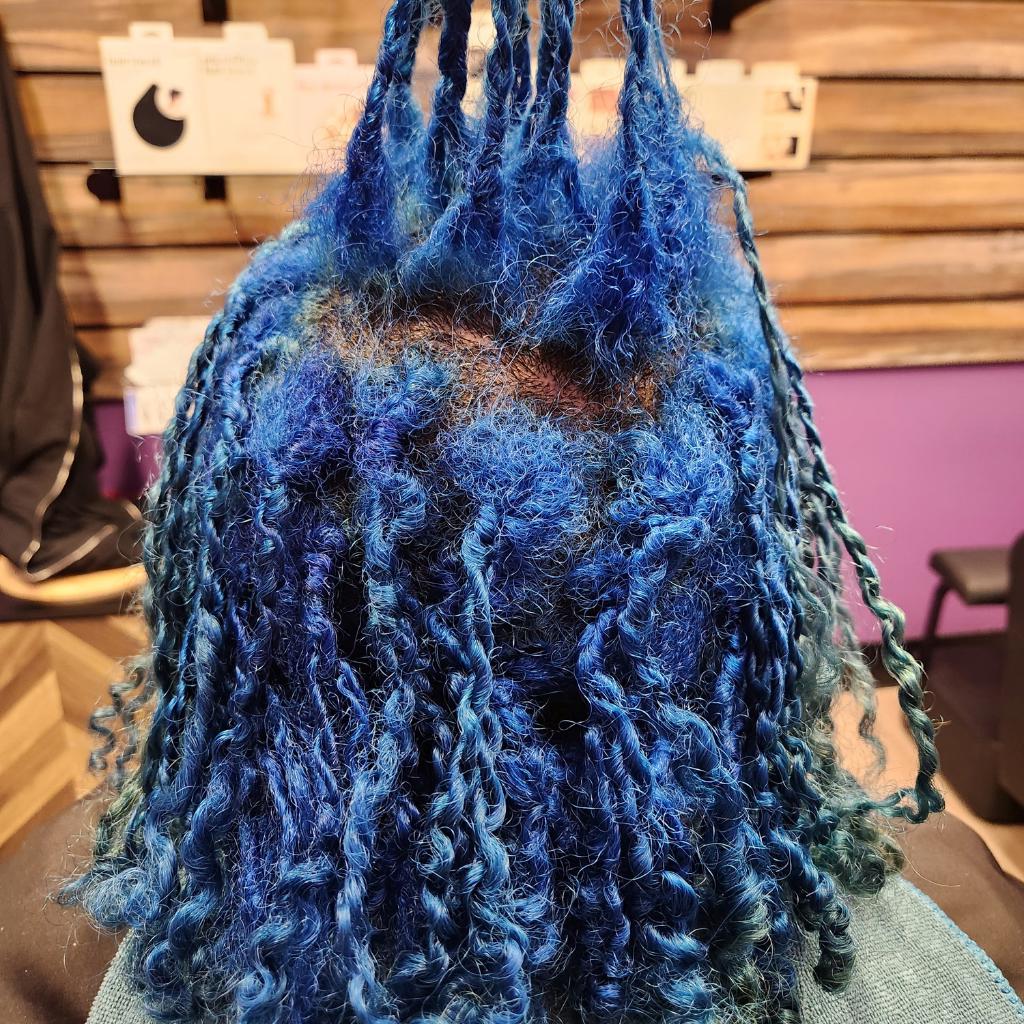
Starter locs often go through stages where they look fluffy, fuzzy, swollen, uneven, or just generally confused about what they are doing.
That does not automatically mean they are failing.
They are forming.
Frizz After a Retwist Is Normal Too
A retwist organizes your new growth and gives your locs a neater appearance.
It does not freeze your hair in place until your next appointment.
Once you start washing your hair, moisturizing it, sweating, sleeping, exercising, wearing hats, dealing with weather, or simply existing as a human being, some of that freshly serviced look is going to soften.
That is expected.
At Serenity, our goal is not to make your hair look like you left the salon every single day until your next visit.
Our priority is keeping your hair and scalp healthy.
If maintaining a perfectly fresh retwist requires you to avoid washing your hair, avoid moisturizing it, or constantly manipulate your roots, we have officially missed the point.
Frizz Does Not Mean You Need Another Retwist
This is an important one.
Seeing frizz does not automatically mean it is time for another maintenance appointment.
Your scalp and hair benefit from having time between retwists. Constantly twisting the roots just because they have gotten fuzzy can create unnecessary tension and manipulation.
A loc can be healthy without looking freshly retwisted.
In fact, your locs are supposed to spend part of their life looking lived in.
That soft new growth at the root? Normal.
A few loose hairs along the shaft? Normal.
A little puffiness after washing? Also normal.
Your locs do not have to stay showroom-ready to be doing well.
What About Loose Hair Around My Locs?
Loose hair around the roots or along the length of your locs can happen for several reasons.
Some of it may simply be new growth.
Some strands may be too short to stay incorporated yet.
Some may work their way out through normal washing and movement.
And some people naturally have hair that frizzes more easily than others because of their texture, density, curl pattern, or environment.
During maintenance, some of that loose hair can be guided back into the loc.
But trying to force every single hair into submission at home can create more problems than it solves.
You do not need to constantly twist, palm roll, crochet, or pick at your locs every time you see something fuzzy.
Sometimes the correct treatment is simply to leave your hair alone.
A revolutionary concept, I know.
When Frizz Might Need a Closer Look
Frizz by itself is usually not concerning.
But there are situations where what looks like “frizz” may actually be related to something else.
For example, it is worth having your hair evaluated if you are noticing:
- Significant thinning at the roots
- Locs becoming noticeably weaker
- Hair breaking around the perimeter
- Excessive unraveling
- Locs repeatedly separating or developing weak areas
- Sudden changes in your hair that are unusual for you
Those situations may need more than a retwist.
Your stylist can help determine whether you are seeing normal loc behavior or something that needs to be addressed.
You Can Have Healthy Locs and Frizzy Locs at the Same Time
These two things are not opposites.
Your locs can be moisturized, clean, strong, growing beautifully, and still have frizz.
The goal of loc care is not to eliminate every loose strand.
The goal is to support healthy hair while your locs mature and change over time.
So when the fuzz shows up between appointments, you do not need to panic.
Wash your hair when it needs cleansing.
Hydrate it when it needs moisture.
Protect it while you sleep.
And give your locs room to actually be locs.
They may not look freshly serviced every day.
They are not supposed to.